
I’ve spent the last couple of weeks in the Portsmouth area, largely focused on the RORC Myth of Malham race. This England place ain’t so bad; the weather’s been superb and the sailing scene is great, a lot of yachting and wider maritime history in this area.
After a day wandering the marinas and boatyards of Gosport (a 2 minute ferry ride from Portsmouth), I tee up some sailing with the Turn to Starboard charity. This organisation uses sailing as a means to support returned servicemen dealing with various difficulties resulting from their tours of duty. From family day-sailing to full RYA yachtmaster training, these guys have really tapped into something special. The yachts offer a chance to escape the stresses of life at home/ashore, and provide an environment for discussion amongst similarly experienced/affected people. While I in no way personally understand military service, PTSD or other afflictions, the idea of peace/healing at sea is something that resonates deeply with me. I guess the cooperation and discipline required to crew a 40′ yacht also go some way to reclaiming a feeling of control, after struggling to deal with day-to-day activities as seemingly benign as grocery shopping or part time work in a cafe. I was lucky enough to go out for a daysail with John Savage (Race Officer) and a couple of the guys involved in the yachtmaster programme. We sail relatively aimlessly through the inner Solent, hoisting the kite for a run down to Cowes for an icecream. Important stuff! The day is filled with great conversation, both serious and not-so (as with most yacht crews), and we return to the marina to pick up a fifth crew member for the RNSA (Royal Navy Sailing Association) race. With nine yachts in the start box it was fun racing; we managed to carry the kite very shy for two of the legs, almost keeping in touch with boats flying asymmetric spinnakers. As the round-the-cans course is set by each week’s duty boat, it tends to be fairly biased towards their strengths. Great fun, and still sailing in shorts and t-shirt after seven pm. The day concludes as every Wednesday night sail should, a couple of pints, a curry, and a heap of bullshittin’ in the navy yacht club.
I joined up with Stu and Mike through the crewseekers site; they’re on the waiting list for this year’s Fastnet (entries “sold out within minutes), campaigning Agamemnon, a Westerly Fulmar 32. Stu’s had the boat for around 13 years, and has been carrying out an extensive refit/upgrade programme over the last year or so, in order to make her both faster, and comply with Cat 2 safety regulations for the races. Major additions include a new inner forestay (for heavy weather/storm jibs), a swish new spinnaker, and a whole heap of safety gear. The Myth of Malham race is one of the qualifying races for the entry in the Fastnet; the race must be completed, plus another ninety odd miles in another suitable race. Up to this point the longest race they’ve done is “Around the Island” (50 nm), and the Myth is almost twice that of my longest (Coastal Classic, 120 nm), so we’re all in for a challenge. Three days before the start we get a fourth crew member (Matt) signed up, which eases the watch system considerably.
I spend two days at Swanwick Marina on the River Hamble with Mike and Stu, testing gear, stowing gear, removing surplus gear. We also get out for a test sail in the Solent, where I get to demonstrate the value of ultra-light kite sheets (thanks Bryon!); in 3 knots of breeze we can just keep her moving, replacing the usual heavy snaplock-clipped sheet with some 3 mm cord, thus keeping the clew flying. It’s a gorgeous day out on the water, although hopefully we get some more breeze for the race. It’ll be a painful drift off if Tāwhirimātea doesn’t turn up. I try to remember the call for wind oft-recited by Captain Keyworth, but the words elude me in a haze of Musket Cove fumes… Matt joins us on Friday evening, and we discuss race tactics at The Old Ship, over a couple of ales and mandatory rum.

The Myth of Malham is a race named after a yacht. The Laurent Giles designed small-displacement racer won the ’47 and ’49 editions of the Fastnet, captained by Captain John Holden Illingworth (himself credited with instigating the inaugural Sydney to Hobart race). “In a radical departure from the norms of the time, Myth of Malham was of light displacement, with short overhangs in contrast to the elongated overhangs of other yachts. Other innovations included a masthead rig, in which the forestay is carried all the way to the head of the mast, rather than terminating lower down the mast as on the fractional rigs which were the norm at the time. The rating rules at the time attached less significance to the area of headsails than of the mainsail, so the masthead rig effectively gave the boat “free” sail area.” What’s sailing, if not finding the loopholes in the rules, and taking full advantage? Cyclors, anyone?
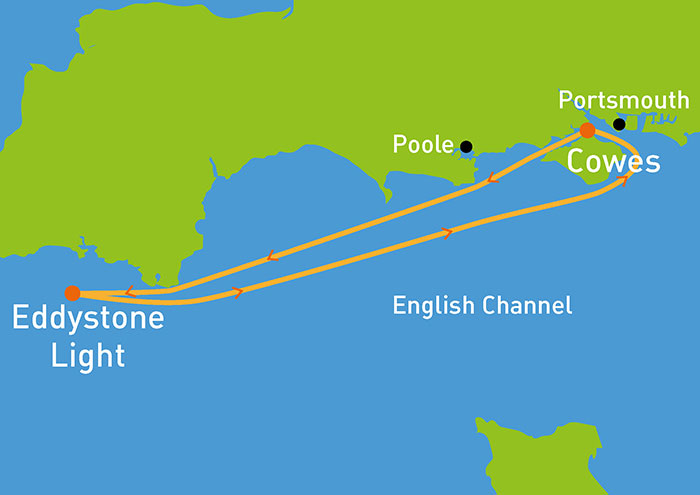
The race starts at 0800 Saturday morning off Cowes (home of the Royal Ocean Racing Club, Isle of Wight), and heads west out of the Solent, with (generally) a long windward beat to the Eddystone light off Plymouth, followed by a downhill run back to Cowes. One hell of a windward leeward! The race usually includes going right around the Island (see below), however is shortened for the 2019 edition to finish at the western end of the Solent. The Solent, and greater South Coast, are notorious for strong tidal streams. Timing the tides is crucial, with gates shutting boats out of headland-roundings if they stick to the coast but miss the change. There are 140 yachts entered in the race, across four classes. Yachts from as far as Ireland and France are competing, and a stand out is the 53ft ketch Gipsy Moth IV, the yacht Sir Francis Chichester set his solo round the world record on in the sixties. I’m surrounded by yachting history here, its awesome.
Alarms sound at 0500, and we’ve slipped our lines to head down the Hamble by 0530. Motoring down the river caffeinating and porridging enthusiastically, we see yacht after yacht being rigged and readied by bleary-eyed crews. Although it’s pleasant to be able to talk with others across the water, the stillness does not bode well for the start of race. Tidal tyrants dictate an exit of the Solent is necessary by around 1300, otherwise we could be dropping anchor… The parade of masts follows us out into the Solent as we pass through the identity gate, registering sail number and number of crew with the committee boat, and allowing inspection of all lifejackets and tethers. I’ve always enjoyed that hour or so before a longer race, as yachts bob and weave in various states of readiness, and bottles of rum are wagered with mount gay abandon.
Our start is confused by a call from the committee boat five minutes out, asking if our AIS is transmitting, they can’t see us on the tracker. Various fiddling and trouble shooting confirms its a problem at their end, and we continue to blast towards the start line at a furious 2.5 knots. The breeze is far from full, and we tack a meandering course to the southwest. Being in the smallest/slowest class, we get the first start time, so the next few hours are dominated by larger hotter yachts rolling over us at a leisurely pace. The breeze slowly builds through the morning to pleasant 12 knots, and we’re maintaining five-plus knots on close-hauled tacks, the wind coming straight out of the southwest. Match racing develops, as we trade tacks with a beautiful old yawl, Amokura. The 50-footer is considerably faster than us, but points up to five degrees lower, so we’re continually crossing lines, and crossing close enough to smell their garlic bread. She’s a gorgeous classic yacht, and appears to be sailing two-handed; pretty impressive. Amokura was built in 1939 and she’s in incredible condition, it’s a pleasure to stay in sight!
Hurst Castle, an artillery fort built in the 1540s to rotect the Solent from wandering French and Roman warships, comes into view by 1130 as the breeze builds to a steady 15 gusting 18. Coming from New Zealand, where few buildings approach two hundred years old, it’s surreal to be sailing past an actual castle. The steep chop in the entrance tells of changing tide, but the fresh breeze enables us to sneak out the gate with a few short tacks, and enter the English Channel proper. We elect to keep it simple and stay offshore, rather than battle the complex inshore tides, bypassing any troubles rounding Swanage and the Isle of Portland.

Once into the channel, we slip into our watch system. Two per watch, 4 hours in the day, 3 hours at night (1900-0700). The length of day being what it is currently, we each have only one truly dark watch per night. Our bearing to the lighthouse is straight into the wind, it’s a long beat to windward on close-hauled tacks. The wind fluctuates in multi hour cycles between 12 -25 knots, with the occasional snotty 30+ coming through. We have the first reef in the main for the majority, occasionally pulling in the second reef and half furling the genoa, while maintaining steady 6 knots of boat speed, pushing 8s and 9s occasionally. The uphill slog progresses through the usual rhythm of helm, eat, sleep, repeat, and we end up rounding the Eddystone Light at 0200 on the Monday morning, less than half an hour behind Amokura. Erring on the side of caution we stick to white sails while it’s dark, but the big gennaker is hoisted as the sun slides up its celestial halyard. As the wind cycles through several strengths and directions, sails are changed accordingly,until we settle into a dead down wind groove with a gull-winged genoa the main pushed as far out as possible, strapped down with a preventer, and a single reef in. We surf along all day like this, rarely dropping below 7 knots, occasionally hitting ten. This is great fun helming, aided by multiple coffees, sometimes rum-enhanced.
The tidal gate swings cruelly shut as we approach the finish, and have to battle the discharge of the western Solent all the way till the end, finally crossing the line at 0130 Tuesday morning. To clarify – in this instance “crossing the line” means a lonely buoy rounding in the dark, no Royal Ocean Racing Club boat waiting to record our humble sail number (the winners finished in 30 hours). We radio in our finish time to a silent receiver, and turn 180 to beat against wind and tide to Poole harbour. Four hours later we’re on the mooring and sleeping like the dead.

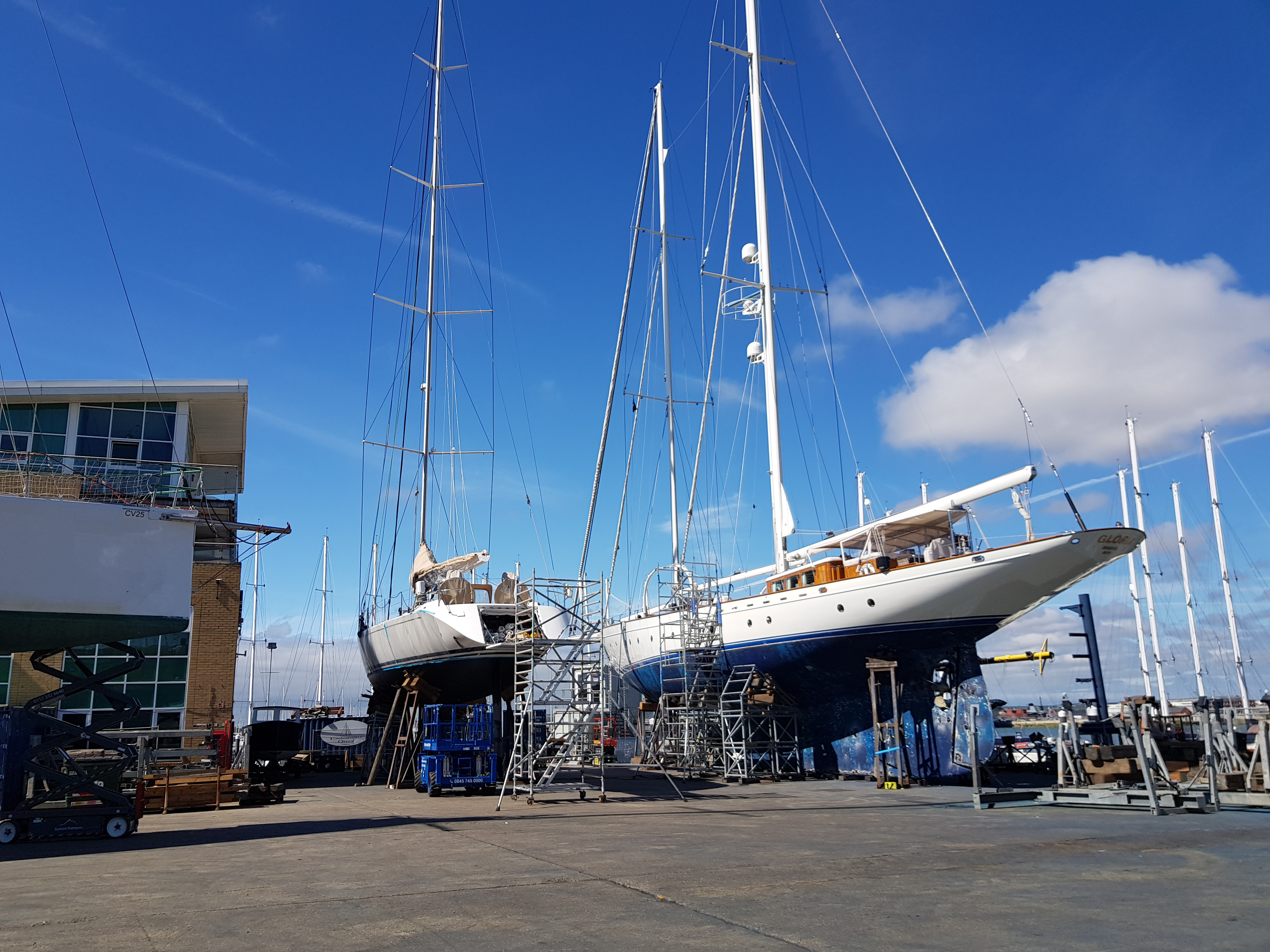
I awake after nowhere-near-enough sleep to missed call from a boatyard in Gosport. There’s a weeks worth of sanding hulls and rolling on antifoul if I want it. I’m in, 0700 the next day, transferring biocidal hull paint from an 82 foot Swan (Dreamcatcher) to my face and hair. Once more, I’m in the presence of yachting greatness; Alex Thompson’s IMOCA 60 is undergoing a refit in the neighbouring shed, prior to a new owner taking possession. Alex Thompson came second in the 2017 edition of the Vendee Globe, the elite solo non-stop around the world race on this boat, and he did most of it with only one fully functional foil. Some seriously hardcore stuff. The boat and performance are legendary, and it’s right there! I also have the high honour of scraping the steel hull of Gloria, the 126 foot Schooner owned by Pete Townshend (The Who). I can only imagine the stories this yacht could tell.


Fantastic Josh, sounds like heaps of fun. I can’t wait to follow your upcoming adventures too. You’ll most definitely have to come and do a talk to the Little Ship Club when you get back to NZ. Fair winds! Viki x
LikeLike
Absolutely! Hope RNI prep is going well!
LikeLike
Love the post Josh – time to schedule a little AK race, eh?
LikeLike
Ready when you are!
LikeLike
Dad’s proud.(and a little jealous)
LikeLike