
In which I meet the lovely Teddy, alongside a host of other characters, in the most interesting boatyard I’ve ever set foot in. Pre-reading forecast: a high chance of technical yacht geekery, with showers of anthropomorphic romanticism. It’s not my fault. I’ve been reading a lot of Moitessier lately.
After a sleep on the floor of the Dublin Airport foodcourt I continue sleeping on a near empty bus to Cork. A good friend’s 30th birthday celebrations in London had done my health no good. A short stop in Cork sees my Antarctic compatriot Hue join me two minutes before the connecting bus to Skibbereen. Impeccable timing. We get to Skib on time to meet Nick, the owner and skipper of Teddy, our home and transportation for the next month. A short drive through the West Cork countryside and we turn through an unassuming gate into Hegarty’s boatyard, which on first impression bears a striking resemblance to a junkyard. But looks can be deceiving. Here, on the banks of the River Ilen in a silent rural setting, is a hive of activity and top rate nautical craftsmanship. Old (pre-1400s old) ivy-covered stone buildings hide timber skeletons of classic yacht replicas, oxidised hulks of steel fishing boats squat over slipways, and various yachts occupy cradles in between groaning piles of soon-to-be transplanted boat organs. Across the river cows look on, chewing their cud in an uninterested gurn. Their interest is not even aroused by a free shower viewing, said shower being a hose hung off the transom of a cradled boat. The next morning a plop plop plop heralds a pair of otters chasing a mallard duck across the muddy intertidal bank. The usually sleek and sneaky mustelids are foiled by the tell-tale mud, and the duck lives to fly another day. It’s a scene straight out of Wind in the Willows, and I’m half expecting a rowboat carrying mole and rat to float around the next bend
“Believe me, my young friend, there is nothing — absolutely nothing — half so much worth doing as simply messing about in boats. Simply messing… about in boats — or with boats. In or out of ’em, it doesn’t matter. Nothing seems really to matter, that’s the charm of it. Whether you get away, or whether you don’t; whether you arrive at your destination or whether you reach somewhere else, or whether you never get anywhere at all, you’re always busy, and you never do anything in particular; and when you’ve done it there’s always something else to do, and you can do it if you like, but you’d much better not.”
Ratty (The Wind in the Willows, Kenneth Grahame, 1908)
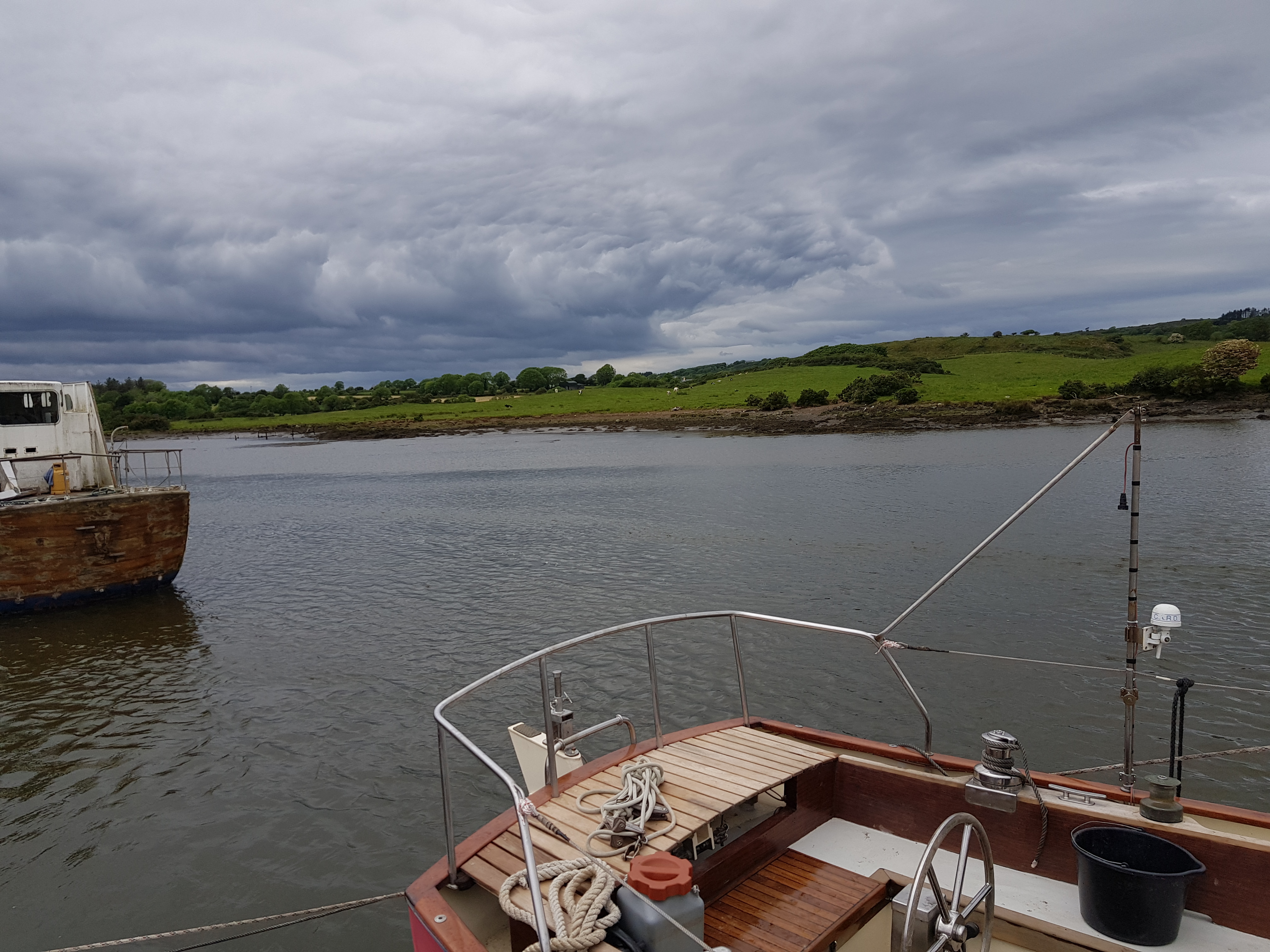
The yard is populated by master craftsmen, and all round good guys, who gather in a stone shed each noon to drink tea, eat cheese sandwiches, and talk about boats. Each of them are overseeing at least three projects at any one time, and bounce from boat to boat in an indecipherable schedule of wood, steel and fibreglass work. Brothers Liam and John Hegarty, sons of the original Hegarty, run the yard, with Liam directing all crane/slip operations. John specialises in traditional strip planking, I spent half an afternoon helping him rivet planks onto a hundred year old restoration sailing dinghy. Painstaking work, but damn it looks good. Folkner (first name unheard) is in charge of large scale replica/restoration work, and his accent is thicker than the wedges of gruyere on his sandwiches; I can barely understand him. Then there’s Nick Kottler, the boatbuilder seconded to Teddy for the last two months. He first met Teddy some eight years ago, scarfing in a new top section to the main mast. Teddy has returned to Hegarty’s specifically for Nick’s craftsmanship, and it’s well worth it. An Englishman living in West Cork for the past 15+ years, Nick can turn his hand to any aspect of boat repair. His work is not only functional and bulletproof, but usually beautiful as well. He’s a real pleasure to work alongside, patiently answering my every question, and explaining in detail various intricacies. His van full of tools and materials is a microcosm of the wider yard. It’s a great system, he know’s where anything is at a moment’s notice, “in the van”.

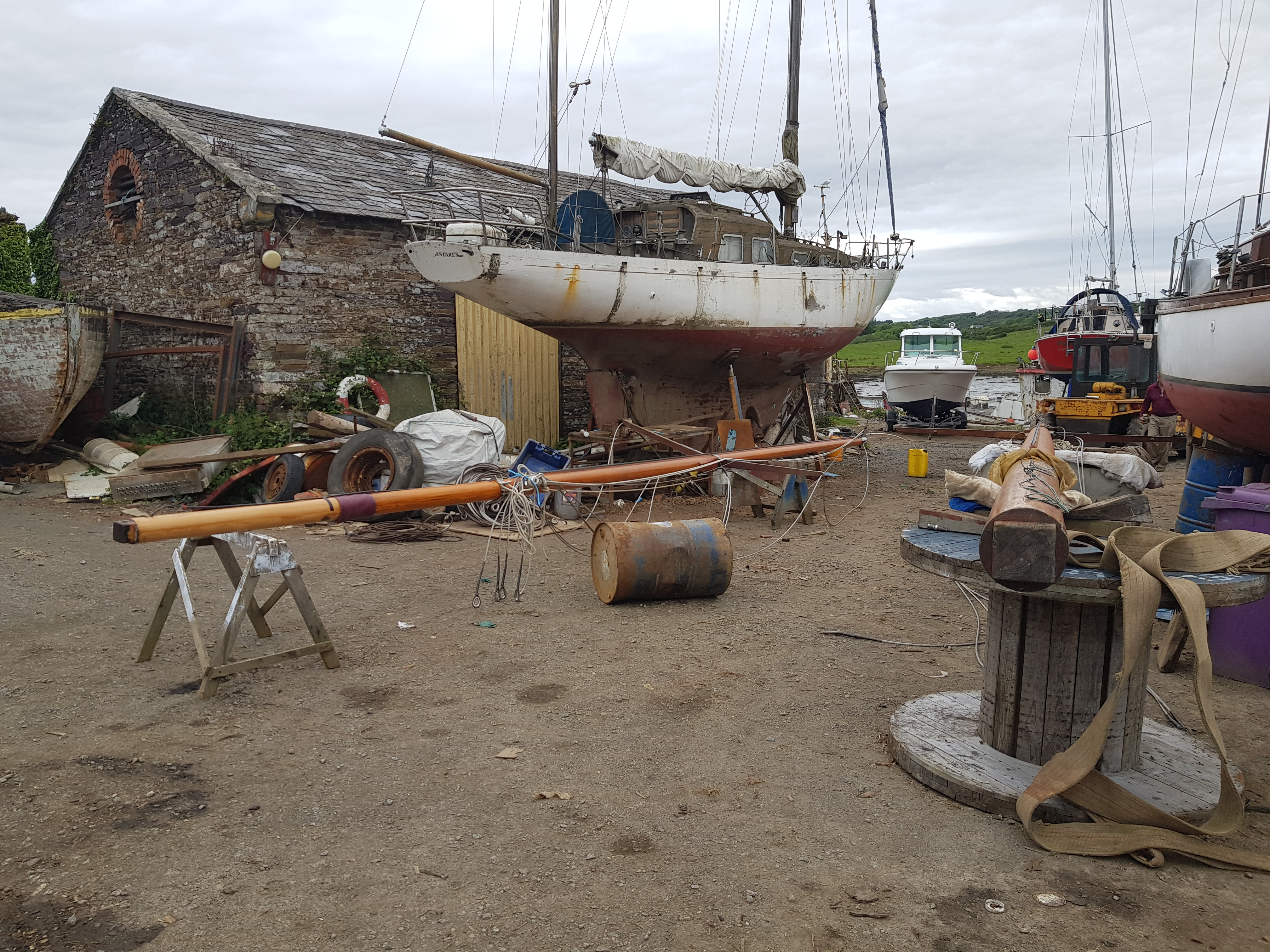
Old and slightly less old.
Two projects undertaken at Hegarty’s really stand out. Firstly, the rebuilding of the auxillary ketch Ilen, which serviced the Falkland Islands for seventy odd years, and was originally built just down her eponymous river in Baltimore. She was rebuilt in the stone Corn Store building, and was an absolute labour of love. The second epic rebuild was a replica of the James Caird, the famed 22.5′ lifeboat that Shackleton, Worsely, Crean, Vincent, McCarthy and McNish sailed 800 miles across the Southern Ocean to South Georgia island, effecting the rescue of all men after the Endurance was crushed by Antarctic ice the year before. It’s a truly heroic story, and a feat of seamanship and navigation; Worsely only managed three sun-sights over the entire journey, and still made accurate landfall. Not only was a JC replica built in the Hegarty’s yard, it was built for a most noble purpose: as a bar to serve a Tom Crean inspired beer at a nearby brewery.

Teddy is built much along the same philosophy as Moitessier’s infamous Joshua (hell of a name for a boat by the way); a 39 foot steel ketch, with long keel and relatively shallow draft. The major deviations really being in plate thickness, cockpit arrangement, and number of pointy ends. Teddy was designed and built by Arne Hedlund in Denmark, 1989 (she’s as old as me, it’s meant to be). Her vital statistics include:
- 39 foot long at the deck, plus an additional 7 foot of bowsprit (33’ LWL). A 20 foot long keel, drawing a total of 6 foot of water.
- The bottom two foot of hull are entirely 20 mm thick steel. All above is 8 or 10 mm thick. The majority of the hull (excluding engine room and anchor locker) are insulated with 2 inches of rockwool. Uninsulated bilges act as below-floor refrigeration. Heating comes via a wood-burning stove (and good stock of compressed peat bricks ) or a back up diesel burner.
- A 49 foot tall main mast (7 foot below deck) of solid Norweigen Spruce (although the top third is a new scarf from a dry-rot induced partial dismasting 8 years ago), and a mizzen of laminated Spruce; both booms are solid Spruce.
- All new stainless steel cable standing rigging, 12 mm for main mast, and 10 mm for mizzen. Main, from masthead: forestay, sidestays (via spreaders), backstay (splits to each quarter), from crosstrees: stay sail stay, double sidestays (fore/aft) and running bacsktays. Mizzen, from masthead: sidestays (via spreaders); from crosstrees: double sidestays (fore/aft); and an adjustable triatic stay linking the two mastheads.
- Sail plan consists of: 2 x Mainsail with three reef depths (slab reefing), 2 x Mizzen with two reef depths, Staysail with one reef depth, 2 x working jib, 2 x Genoa.
We were working on Teddy from the 12th to the 16th of June (although both Nicks have invested over two months in this project), readying her for our push to the north. A non-exhaustive list of the jobs undertaken by Hue and I over those days includes:
- Clean all stainless rigging bolts with nitric acid
- Whip loops of sidestays (stays below the crosstrees are not fixed to the masts, but looped around and sit atop a hardwood shoulder)
- Fix sail tracks to masts, carefully countersinking each screw to ensure no jamming of sail sliders
- Connect new VHF antenna (salvaged from fishing boat) to mizzen mast wiring, radio check with local coastguard
- Rewire masthead lights
- Connect and triple check all stays and halyards to masts
- Stand and step the masts (more on this below)
- Seal all portlights
- Fit booms and sails, fix all running gear to decks
- Hoist Hue up the main mast to connect the triatic stay
- Fix compass to mizzen mast, winch and cleat collars to both masts
- Install new bracket and bracing for vertical axis wind generator
- Secure fuel return hose and stern-gland bleed pipe
- Refurbish spare toilet pump
Standing and securing the masts involved a coordinated ballet of men, boats and a crane. Not a single health and safety form was filled out, the job got done, and everybody lived. The operation required high tide in order for Teddy to be within booms reach of the crane, although she needed a smaller boat between her and land to achieve the right swing radius. All rigging was again independently re-checked by Nick and myself, prior to attaching strops to the crane hook. Multiple seasons of manning the foredeck have instilled a healthy paranoia around masthead tangles and general rigging cock-ups; thanks to Bryon, Craig and others for the gentle instruction! With Liam operating the crane, we had one man on a line wrapped around the base of the mast, controlling Y-axis swing, with others waiting on deck to receive the dangling spars of spruce. Maintaining verticality of the mast via the lower line required a graceful dance from shore to intermediary boat to Teddy, and multiple hand signals were used to communicate issues back to the radio-less crane. The mizzen was stepped first, both due to positional ease, and as a dress rehearsal for the larger main event. The whole thing went relatively smoothly, apart from a puzzling phantom floating foot in the the first stepping of the main, easily remedied by a second lift-jiggle-drop maneuver. Masts stood and unstayed (fairly supported via through-decks) Teddy was moved back to deeper water; multi-metre tidal drops are not kind to partially installed standing rigging… The next few hours involved slow and steady tightening of all the new stainless rigging, including a bosun’s chair trip up the main to re-align the afore-mentioned sidestay round-mast loops. We worked through till 2200 (still light enough) as wet weather was forecast for the morning. Successful day all round.
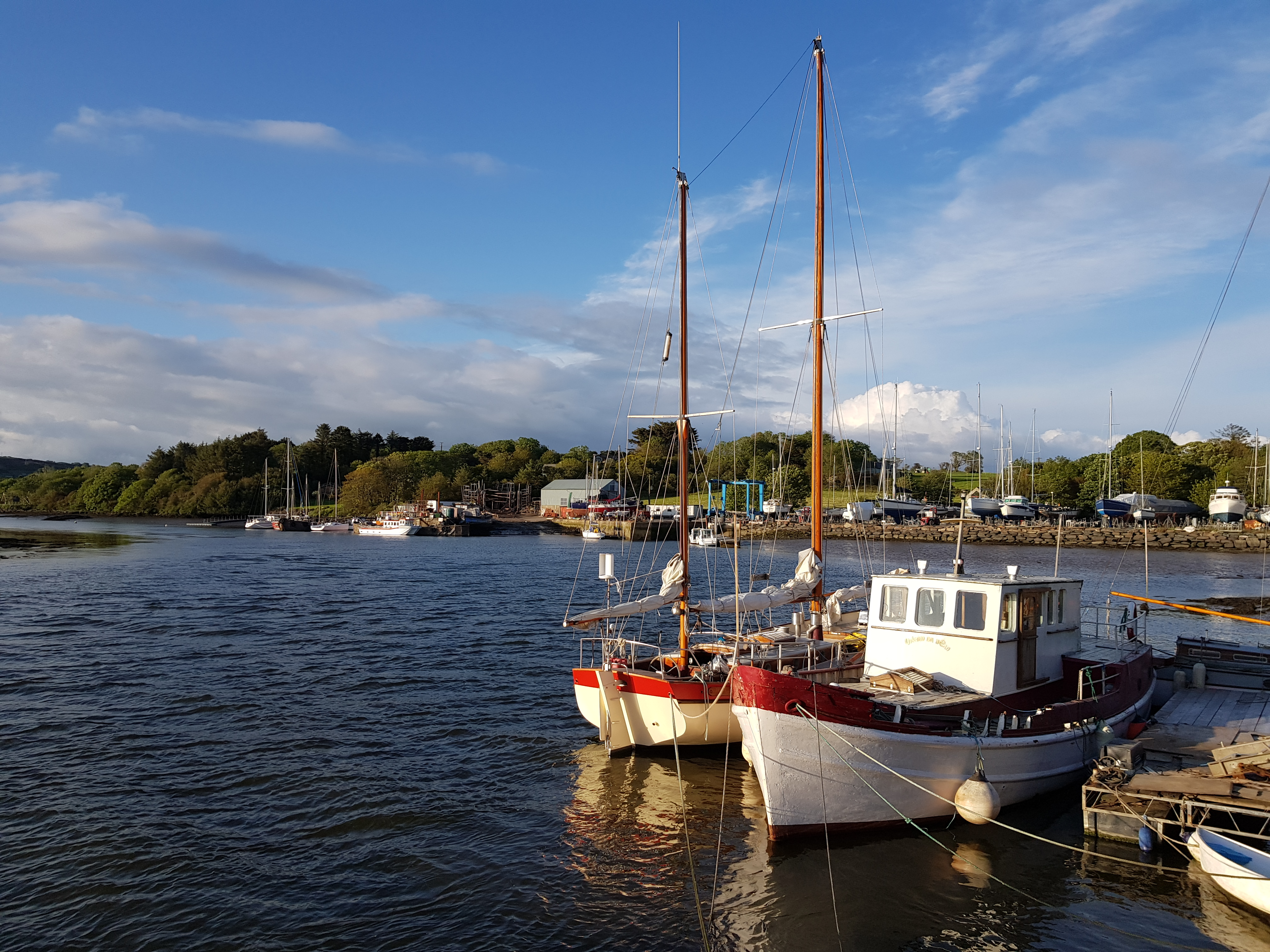
Teddy all dressed up and ready to boogie. Looking fiiiiiine.
Provisioning took a whole Saturday morning between the Skibbereen farmers market and various supermarkets. The market was excellent and we stocked up on local organic produce. A great contrast to previous offshore trips, as the temperatures will enable better storage of perishables. A stark illustration of our relative priorities was given by our vegetable and cheese bills. Where I got a literal crate full of spuds, onions, carrots etc for 60 eu, Hue spent 50 eu on a small bag of artisan cheeses. Seems about right! Salami, chorizo, bacon, anchovies, Guinness, oats, pasta, chocolate, RUM. Sorted.

We left Hegarty’s early Sunday afternoon, heading downriver for a night in Baltimore. Nick Kottler joined us as river pilot (not to mention pizza eater and pint drinker), helping negotiate the various mudbanks down the Ilen, with assistance from his young son, Marcal (sp?). The trip down river was beautiful, low rolling green fields with exposed granite outcrops throughout. Old stone buildings covered in ivy dot the fields, cormorants swoop overhead, and the occasional otter floats past in a buoyant doze. Upon arrival at Baltimore the shore facilities were used to their utmost. Showers, laundry, beer and pizza (not necessarily in that order) before a toasty night aboard Teddy waiting for our 0400 departure. We planned a 3 day cruise up the Atlantic coast, stopping in Clifden (where Nick lives) to pick up a few more bits and pieces, prior to finally pushing northwards and getting offshore.
I’ll introduce the crew in the next post; Nick is much more than just owner/skipper, and there’s more to Hue than Antarctic experience and a rampant cheese dependency.
Sláinte!
 Rum, Salt and Bullshit
I love you Joshua. Stay safe. Stay strong.
LikeLike
Chur Aunty HB! Love youse too! Sounds like you guys need the strength after the cricket…
LikeLike
I want to go traveling with you sometime!
LikeLike